The Democratic Hangover
GötterDemmorung in Armenia

It's stormy in Vanadzor, Armenia’s third city, on the road running north to Georgia. Lightning flashes in the early hours of the morning over hills of Lori, unanswered by thunder.
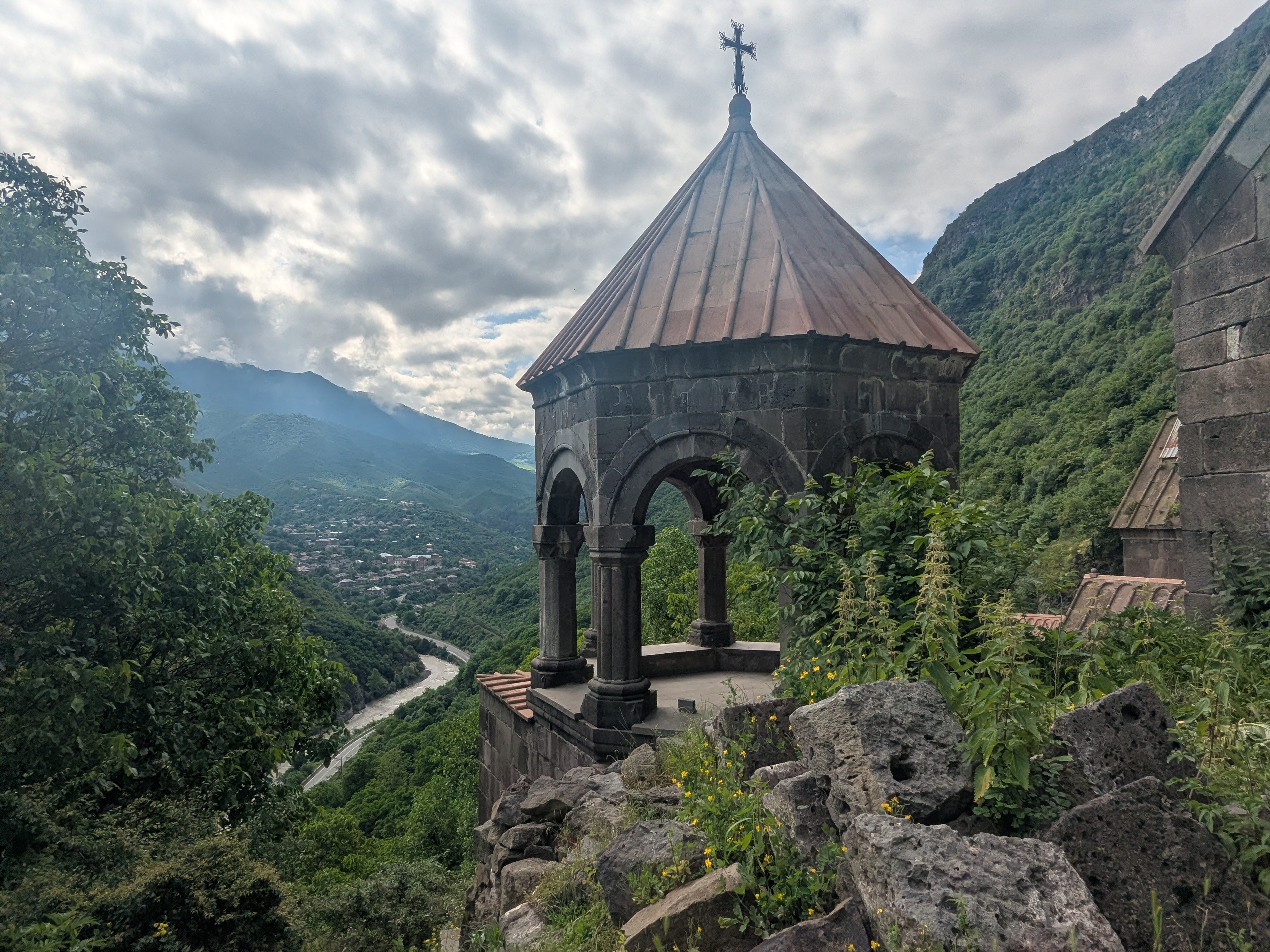
The Lori hills from Kobayr. I can't put you through another picture of Nikol.
This is a brief follow-up to my pre-election piece which you can read here.
Election posters are more prominent here than the capital, continuing to stare down in the days after the vote. Particularly prominent is runner-up Samvel Karapetyan, a position he was unable to play in the campaign, being under house arrest. In Wagner's Götterdämmerung, the gods are absent, save in the memory of the humans in ritual and invocation. Armenia has been through its democratic ritual, though there is still mopping up to be done.
Nikol Pashinyan declared himself victorious in the early hours of Monday morning when the count had barely begun. Western leaders sent their congratulations. Amid irregularities, recounts and controversies, the final makeup of parliament is still to be decided, but Pashinyan retains power.
The principal controversy is over disappearing ballots for the fourth-placed opposition party, Gagik Tsarukyan’s Prosperous Armenia. A party needs 4% support to enter parliament; results have him just below this level. A few dozen votes are the difference between whether or not he gets in.
Pashinyan secured a majority on just under half of the votes - enough for a comfortable majority but just short of the 60% of MPs which would allow him a certain constitutional leeway - if Prosperous Armenia make it in. Either way, he will remain short of the two-thirds ‘supermajority’ which he was seeking, in order to amend the constitution to drop recognition of Artsakh - demanded by Azerbaijan in its ‘peace’ negotiations.
All three principal opposition parties are demanding recounts, although the electoral commission (controlled by Pashinyan allies) will allow only a handful. Politicians will grumble over late voting, missing ballots and a large increase in rejected votes.
But the big picture is: Pashinyan retains power, that is de facto near absolute, if not de jure. And the problem of democracy remains: one which constitutionally and practically favours the incumbent, and with it the interests of the West, so markedly displayed in the campaign.
Few seem to be asking: is it even believable to think that Pashinyan got 50% of the vote at all? One opinion poll is particularly revealing. The pollsters Breavis (pro-Western, conducted for the American International Republican Institute) presented a poll giving Pashinyan’s Civil Contract party a 65% share - by excluding an astonishing 51% don't knows/non-voters! Second place Strong Armenia were put at 12%, well short of the 23% of the preliminary results.
Peter Hitchens’ dictum that polling is meant to lead, rather than reflect public opinion has never been more true. The dishonest presentation was surely meant to normalise Civil Contract’s narrative of needing a supermajority for peace - and settling for a solid Nikol victory.
In reality, in an environment where opposition politicians continued to be arrested up to election day, it is not surprising that so many refused to answer a pro-Pash pollster if they supported the opposition. But it's a useful guide to an upper bound for his actual support - surely sub 40s rather than nearing half.
Which is not to say that the difference is entirely fraudulent. In rural Armenia, voting on a ‘client’ basis extends to families, and pressure brought to bear by government employees will have had an effect. And some will have held their noses and voted for the evil dwarf they know.
The problem is democracy itself, particularly given the circumstances of this election. This was exacerbated by the large number of parties which had no realistic chance of reaching the 4% threshold, effectively throwing away opposition votes and consolidating Pashinyan's hold. Their candidates were foolish at best, deliberate distraction at worst.
Given this, it would be wise for the opposition parties to focus on the big picture, rather than the messy details of democracy. Pashinyan has already packed the judiciary and other public appointments - the opposition won't be able to reverse this with or without him achieving 60%. Focus on the issues key to the country - geopolitical, economic, security above all.
It is better to discredit democracy than compromise with it.
Of all the Western leaders offering their premature congratulations to Pashinyan, one has been notably absent. Trump has not thundered from Washington, caught up in the resumption of the war on Iran.
At least he's honest - for the West, the election was never about Armenia.