Israel Not-Quite-First
US policy in the Middle East is not as simple as it appears

It’s a common meme on the MAGA-sceptic right: the policy of the Trump administration presents itself as America First, but is in reality a cloak for Israel First. It is my contention that events on the ground do not back this up (at least entirely), and that moreover, it is a good example of the continuity of US policy across administrations, not a rupture across them.
First things first: I am not for a moment claiming that the US is not (and will not continue to be) the principal backer of Israel in a existential way, and I’m not denying the pervasive influence of the Israel lobby in US politics more generally. That much, I hope, we all take for granted. And I’m no defender of US hegemony or the ongoing designs of Israel and Turkey to rewrite the geopolitical map of Western Asia. My purpose here is to show that the US is playing a wider game than most commentators admit, even to the point of restraining the worse impulses of Netanyahu - whilst (for the avoidance of doubt) indulging Israel’s ‘internal’ affairs in the Gaza war.
We’ll look briefly here at three cases which are still ‘live’ as I write: Syria, Iran and the Gulf of Aden conflicts.
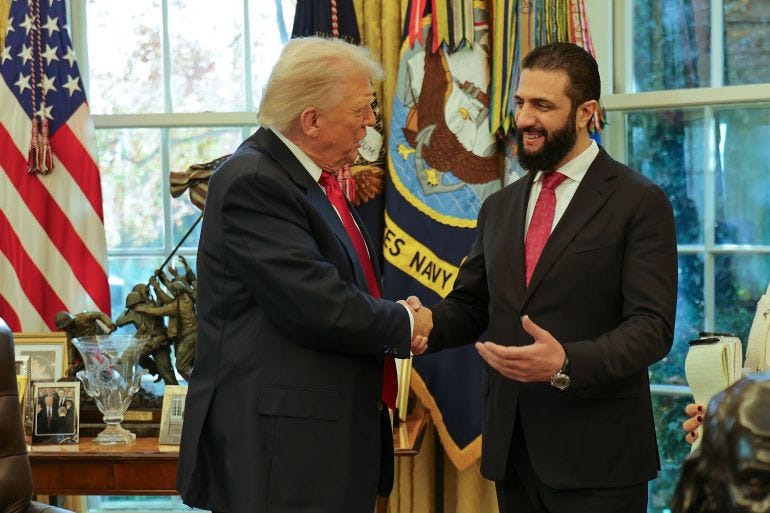
A terrorist in the White House
The Monkey in a Suit
A brief reminder of the events surrounding the fall of Assad’s regime and the installation of Abu Mohammad al-Jolani and his rebirth as Ahmed al-Sharaa. I’ll continue to call him Jolani - a monkey in a suit is still a monkey.
Turkish-backed Hay'at Tahrir al-Sham (HTS) forces advanced from their base in Idlib in the north of Syria on 27 November 2004. Aleppo fell with little resistance two days later, and HTS advanced south down the main M5 road, taking Hama (30th), Homs (7th December) and Damascus itself the next day. Apart from some resistance of the Syrian Arab Army (Assad’s forces) before Homs, their vastly superior forces (170,000 to HTS’s estimated 20-25,000) largely melted away.
Israel agreed a truce with Hezbollah in Lebanon on the same day as the HTS campaign began. It advanced from the (occupied) Golan Heights to Mount Hermon, but their major contribution was a massive campaign of destruction of the SAA’s assets - first the air defences and air force, then the naval fleet.
Russia conducted a couple of strikes against Idlib, but by 2 December started sailing its navy from the port at Tartus into the Mediterranean. Iran did nothing, beyond evacuating its military and diplomatic advisers.
Assad himself had flown to Moscow shortly before the HTS offensive to meet Putin. He was reported to have flown back to Damascus (understandably); but although although statements from the capital were issued in his name, he did not appear in person. He was reported to be given asylum in Russia and flown out on 8 December; his close family were in Moscow before the short campaign. He is reputed to be living in a Moscow apartment and enjoying playing computer games. He has not been seen.
The only reasonable explanation for the swift fall of Assad is that it was a joint operation between Turkey and Israel, and a deliberate strategic withdrawal by Russia. Iran’s bewildering lack of action supports this - unlike Russia, Iran’s interests in Syria were existential, as part of its ‘forward defences’ against Israel. My supposition is that they were informed it was a ‘done deal’, and possibly squared by Russia with an improved defence pact (signed in January 2025). Whether Assad is alive must be questionable, but the story of him returning to Syria is not credible.
Regime change had, of course, long been a goal of the West, with US forces supporting the Kurds in the north-east. It has emerged since that British intelligence has also played a key role:
Richard Moore, the former head of MI6, said in September that the UK government “forged a relationship with HTS a year or two before they toppled Bashar” which he said had allowed the UK government to “return to the country within weeks” of Mr Sharaa taking power.
It is also telling that Moore chose to deliver his outgoing speech as head of MI6 in Turkey - the start delivered in his fluent Turkish: ‘On almost all of the issues that I have grappled with as Chief of MI6, Turkey has been a key player.’
In addition, Jolani had been courted for years by none other than current National Security Adviser Jonathan Powell (Blair’s old financial fixer and right-hand man). Through his organisation Inter/Mediate, Powell first met the HTS leader in 2015. Inter/Mediate had two ‘charity consultants’ inside the presidential palace in Damascus as soon as Jolani took charge.
Fast forward to the current year: Jolani has concentrated power, with high-profile visits to world leaders - up to the White House - in his smartly-tailored suits and trimmed beard. Repression against minorities has been brutal at times, particularly for the Christian, Alawite and Druze communities, but the country has not seen the sort of break-up (formal or informal) that many were predicting, and was widely assumed to be the goal of ‘Greater Israel’. Finance minister Bezalel Smotrich was quoted last year:
With God’s help and the valor of your comrades-in-arms who continue to fight even now, we will end this campaign when Syria is dismantled, Hezbollah is severely beaten, Iran is stripped of its nuclear threat, Gaza is cleansed of Hamas and hundreds of thousands of Gazans are on their way out of it to other countries, our hostages are returned, some to their homes and some to the graves of Israel, and the State of Israel is stronger and more prosperous.
Syria has not been dismantled. The Kurdish Syrian Democratic Forces (previously backed by the US) have seemingly come an agreement with the government after Jolani’s forces retook Aleppo in January, and advanced into SDF territory. The US has, it appears, chosen to back a united Syria - and therefore Turkey - over Balkanisation and control. ‘The Syrian government received a separate message from Turkey that Washington would approve an operation against the SDF if Kurdish civilians were protected’, claims a source. This gives Damascus territorial integrity in the north east, and also access to Syria’s oil. And Turkey neutralises the prospect of an quasi-independent Kurdish ‘state’, whilst increasing the possibility for economic and political influence.
Israel is not happy about this. It has used the pretext of ‘protecting the Druze’ to build its own sphere of influence (at least) in the South, and bridge towards what was previously SDF held territory across the Euphrates. ‘Today, Israel also fears al-Sharaa government will reach a similar agreement with the Druze in the province of Sweida, south of the country’ claims this source. Israel responded with increased IDF patrols into the Druze areas.
It is striking that the initial campaign against Assad was undertaken under the Biden ‘presidency’, but the thwarting of Israeli interests has happened under Trump. At the time of writing, it is unclear whether Jolani’s forces will consolidate Druze control in a similar fashion to the Kurds, and how Israel will respond. But, ‘Sources said Netanyahu is angered by the outcome in northeastern Syria and considers US Special Envoy to Syria Tom Barrack biased toward Ankara. The Israeli circles see Turkey as the ‘biggest winner’ from the collapse of the SDF.’
Syria is looking increasingly like a Turkish proxy rather than a carve-up under the pretense of federalisation - Israel’s preferred option. What regime change did do was allow Israel to destroy all serious Syrian military capability (Jolani was not to be allowed that), giving it unimpeded airspace to strike Iran.
The Twelve-Day Kayfabe
2025’s Twelve-Day War even seems named as a posture: twice as good a six days! The Trump/Netanyahu double act did leverage distinct tactical advantages in timing, twice luring Iran into false confidence. One strongly pro-Israel US source1 described is as ‘the greatest political deception since Project Overlord’ (where the allies led to Germans to believe the Normandy landings would take place near Calais). Trump’s talk of giving the Iranians two weeks, and a publicised meeting with MAGA hawk Steve Bannon2, lured Iran into laxity, easing the passage for the early assassinations (thirty generals in the opening strikes, in the grimly names ‘Operation Red Wedding’). Then, a temporary ceasefire together with further overtures of negotiations preceded the US direct strikes on 22 June - at minimal risk to the US, after Israel had first secured aerial dominance in the opening phase.
It appeared to be a well-executed and co-ordinated plan, yet the simplistic claims of success did not stack up. Trump declared that Iran’s nuclear facilities had been destroyed, an unbelievable statement that was contradicted even at the time by published US intelligence. It is even unclear how much the US strikes damaged the best defended site, buried in the mountains at Fordow. And Iran likely relocated part of all of its enriched uranium in advance of the attacks anyway, leading to some suspicion that they had been forewarned.
Iran’s response was calculated. Early missile (cheap drone) launches were designed to soak up Israeli defences; as the war went on, faster and better missiles were then able to get through. Five IDF bases were hit. And Iran’s response appeared to be ‘deliberately calibrated’:
Following an Israeli drone strike targeting an Iranian oil refinery in the South Pars gas field, Iran responded by targeting a refinery in Haifa. After Israeli airstrikes targeted Iranian research centers suspected of involvement in nuclear activities, Iran retaliated by striking the Weizmann Institute of Science near Tel Aviv—a facility long suspected of playing a role in Israel’s own nuclear research. Through these reciprocal attacks, Iran aimed to signal its capacity for measured retaliation and to reinforce its deterrence posture. Notably, both sides refrained from targeting energy infrastructure after the initial exchange.
Even Iran’s response to the US bombing - the attack on the US Al Udeid air base in Qatar - was ‘telegraphed and limited in impact’.
Some costs were real enough. Over 1,000 Iranians were killed over the twelve days - many indiscriminately, such as the attack on Evin prison, described by Human Rights Watch as a war crime. The twelve day war is estimated to have cost Israel $40 billion in direct and indirect costs - or 7.4% of GDP. Iran demonstrated that it could inflict significant damage to Israel. A ceasefire was announced in time for Israel to replenish its stocks of defensive missiles.
As for Israel’s principal goal of regime change in Iran, if not full on civil war, the war did little directly. This year’s protests are undoubtedly fuelled to some extent externally, but the economic and infrastructure concerns of Iranians are real enough. They aren’t helped by the fantasies of Pahlavists protesting in the West, their pre-revolutionary flags joined with the Israel’s, calling from afar for their homeland to be bombed.
US policy does not seem so short-sighted; Trump has gone public with doubts over a Reza Pahlavi ‘restoration’. Despite Trump’s words, nothing tangible was done to stop January’s protests while they were taking place. Western media still pumps expat Iranian opposition figures of 36,500 killed in the protests, whist Iran has taken the step of publishing the names of those killed (just over 3,000) making it a falsifiable claim. If the USS Abraham Lincoln strike fleet (currently sheltered off Oman) is there for anything more than show, it won’t be because of the protests.
The New Aden Emergency
The third area of strategic interest for Israel spans both sides of the Gulf of Aden - the Yemen civil war, and Somaliland. In both cases, Israel is less directly involved than Syria or Iran, but its close ally the UAE is.
Somaliland (prior to independence the British protectorate of Somaliland) has been de facto independent from Somalia (previously Italian Somaliland) since 1991. The two had formed an uneasy union on independence in 1960, in a state of civil war from the start. Israel became the first country officially to recognise its independence on Boxing Day 2025 (you can be forgiven for missing it). Landlocked Ethiopia signed a memorandum that it would recognise Somaliland in return for a lease of port facilities. One of our own high profile supporters of independence is Nigel Farage.
When asked if the US would follow suit, Trump’s reaction was interesting:
‘Just say, ‘No, not at this —,'” Trump told The [New York] Post in a phone interview, before modifying his answer on recognizing Somaliland to: “Just say, ‘No.'“… “Does anyone know what Somaliland is, really?” Trump asked aloud from his golf course in West Palm Beach.
At the UN, the US deputy ambassador ‘clarified’: ‘On the matter of Somaliland, we have no announcement to make regarding U.S. recognition of Somaliland. And there has been no change in American policy.’ This falls some way short of the UK’s statement that it ‘reaffirms its support for the sovereignty, territorial integrity, political independence, and unity of Somalia.’ But the recognition of Somaliland is certainly on the neocon agenda: it was recommended in Project 2025 as a counter to China’s influence in Djibouti.
Israel’s diplomatic recognition of Somaliland prompted a flurry of claims that it was going to resettle the population of Gaza there, but the reality is more about the geopolitical chessboard. Somaliland authorities rushed to deny Somali claims of the resettlement of Gazans, or that there were plans for an Israeli military base. At the least, UAE investment and Israeli recognition draw the fledgling territory tight to their camp.
Turkey, meanwhile, has strengthened ties with Somalia, signing a defence a co-operation pact and investing. Mogadishu is home to Turkey's largest overseas military base, and beginning construction of a ‘space port’ for testing long-range ballistic missiles.
Recognition was also prompted by matters across the Gulf of Aden. The Yemeni civil war is multi-sided. The Houthis have control of what used to be North Yemen, but non-Houthi areas were until December last split between the ‘official’ government forces, the Presidential Leadership Council (backed by Saudi) and the Southern Transitional Council (backed by the UAE); as well as some more minor militia. Let’s take a look at the map:
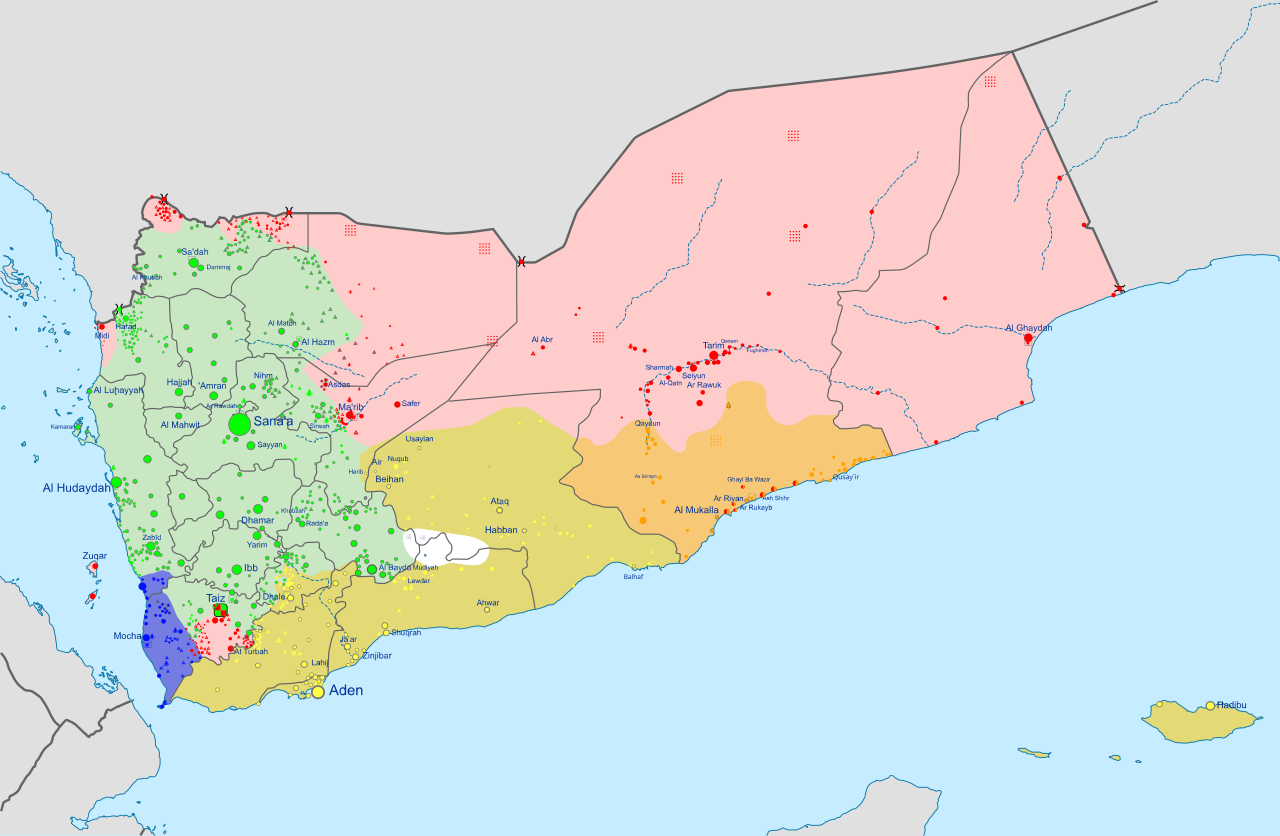
Yemen at the start of December: Houthis (green), PLC (pink) and STC (yellow)
From the 2nd to the 26th December, STC forces swept through almost all of the PLC territories. The Saudis amassed forces by the border and then struck back, launching air strikes on the 26th. On the 30th, the Saudis hit two UAE ships in Mukalla said to be delivering a large shipment of arms to the STC. By 7th January, Saudi/PLC forces had taken Aden and routed all of the STC, whose leaders fled. Marco Rubio met his satisfied-looking Saudi equivalent the same day. The UAE announced that it had ‘ended its mission’ (of a decade) in Yemen. It was a stunning reversal.
The US seems to have acquiesced in this; long-standing policy has been to recognise the valid security concerns of Saudi Arabia on its southern border, to the point of accepting a degree of rapprochement between the Saudis and the Houthis. Saudi interests appear to have trumped the possibility of using Aden as a base against Houthi activities in the Red Sea (traffic through the Suez Canal is still running at around half that of two years ago in terms of number of ships, and a third in tonnage)3.
It is reported that the Mossad had been courting Somaliland for years, but Netanyahu announced his support for independence on the very day the Yemen conflict turned. It establishes the possibility of a base for operations against the Houthis a possibility explicitly recognised by Israel’s Institute for National Security Studies. And unlike in Yemen, it is a ‘win’ for Israel which does not come with any direct costs to the US.
The Israel-First Presidency?
Putting things together, we see a picture that doesn’t entirely support the notion of an Israel-First Presidency. Syria appears to be undergoing a consolidation under Jolani and the influence of Turkey, rather than the fragmentation that Israel was looking to exploit. The twelve day war breached a significant threshold with a direct attack by America on Iran, but had many elements of appearing choregraphed, and did not achieve any of Israel’s strategic goals of a denuclearised Iran under a different regime. The US appears to be relaxed about increasing recognition of a Somaliland under Israeli-UAE domination to counter Saudi gains in Yemen.
In rough terms, whilst Israel has seen some benefit from all three areas over the last year-and-a-bit, its maximalist aims have seen a loss in Syria, a draw in Iran (for now) and a win in the Gulf of Aden.
In contrast, Turkey has improved its position considerably; not just in Syria but also with the Turkish-Azeri ‘TRIPP’ plan subjecting Armenia to Turkic interests. I have written before about the ability of Middle Powers to leverage all sides in the developing geopolitical environment, and none is exploiting this as well as Turkey. Israel, by contrast, is in a strange position: existentially backed by the US (and of course its own potentially suicidal Samson doctrine), but with limited ability to leverage other powers.
I’m not foolish enough to make any firm predictions in such a fluid situation, particularly whether another Iran attack will happen, which is all too possible. But my point is that there is evidence that the US is acting as a restraining hand on the worst desires of Israel. If only Nixon could go to China, perhaps only Trump can control Netanyahu. I, for one, hope so.
The ‘School of War’ podcast
Bannon’s prominence in the latest release of Epstein files asks some questions about his true position as a ‘hawk’